
How inflation affects Forex, Stocks & Commodities
Reading time: 12 minutes
Inflation is the rate at which the overall level of prices in an economy rises. Although the concept of inflation is simple, newer traders often misunderstand its definition. Inflation is the overall increase in prices; for example, something costing US$120 today, up from US$110 a year ago, represents about a 9% increase. That is inflation.
However, you will also hear economists regularly use the terms ‘disinflation’ and ‘deflation’. It is these two terms that I find newer investors initially struggle with most. Disinflation is essentially used to describe prices that are rising, but at a slower pace. Imagine a good rising 10% from US$100 to US$110 (inflation), then the next year prices rise from US$110 to US$115 (4.5%), and the following year, prices rise to US$116 (0.9%). This shows that the price of the good is rising, but the growth rate has slowed: disinflation.
With deflation, prices fall. So, if a new premium good just came out at US$1,000 and the next year it costs US$950, this is deflation. The same could be said for a haircut: if this cost you US$20 one month and US$18 the next, this is also deflation as the price of the service fell.
Pull or push inflation?
Inflation can impact the economy in many ways, with two core realities: cost-push inflation and demand-pull inflation. The former is a scenario in which companies face rising costs and raise their prices to cover the increased expenses, while the latter is too much money chasing too few goods and services – think of it like when you want to buy more of something than businesses can produce, naturally sending prices higher.
Understandably, as prices rise, this reduces purchasing power, meaning today’s dollar buys less than it did. To maintain your standard of living, either your income must rise in line with inflation or your investments must produce a return above what inflation is.
How is inflation measured?
Confusingly, inflation is measured using several different metrics. However, the most common and widely followed metric is the Consumer Price Index, or ‘CPI’. Imagine we take the average price change in a shopping basket of everyday goods and services that consumers buy every month; that is what the CPI is, in a nutshell. Technically, this is referred to as the ‘all items’ index, while economists and policymakers also track the core measure, which is a metric that removes price changes for volatile food and energy in order to help track inflation trends.
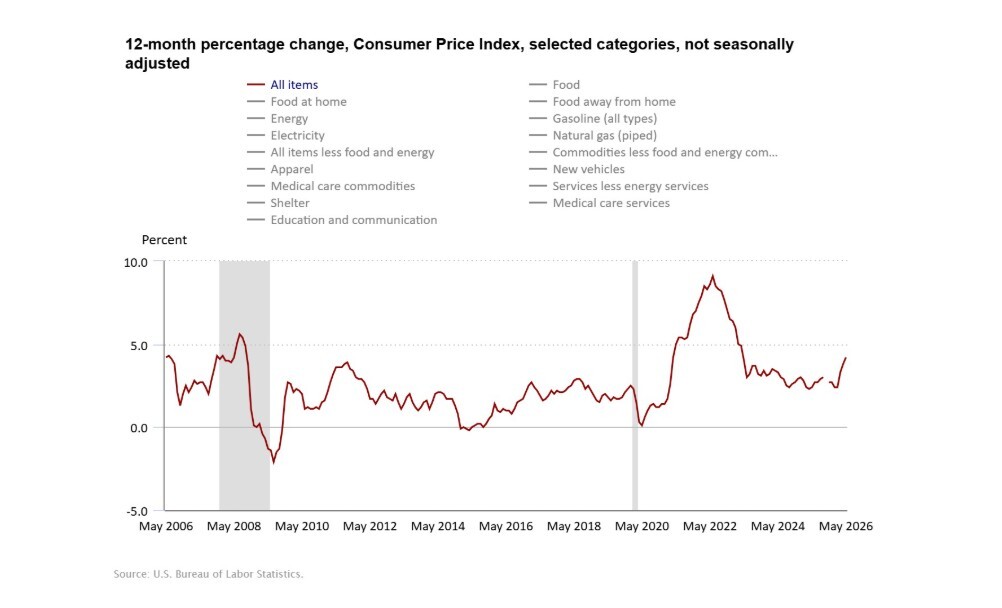
As you can see from the line chart below, the US CPI inflation data (provided by the Bureau of Labor Statistics) eased from a peak of 9.1% in 2022, found a bottom just north of 2.5%, and has since risen to 4.2%.
Other indicators worth spending time understanding are the following:
- GDP deflator (Gross Domestic Product), which divides nominal GDP by real GDP to derive a ratio of current-year prices to constant base-year prices.
- The Producer Price Index (PPI), which is the prices paid by producers/manufacturers.
- The US Personal Consumption Expenditures (PCE) price index, which takes a slightly different approach to CPI. Although it measures consumer inflation, it accounts for substitution effects, whereas the CPI implements a fixed basket.
How does inflation affect the Forex market?
When I see a stronger-than-expected inflation rate, my immediate thought is what this means for interest rate expectations. In fact, this is one of the key things you – as a Forex trader – should be asking yourself when important data comes in different from what markets had priced in (expected).
As I am sure you are aware, the Forex market consists of currency pairs, meaning you are essentially looking at two different economies and their exchange rates. Consequently, you are not just assessing inflation in one country; you are also looking at it relative to another country.
For example, if you trade the euro (EUR) against the US dollar (USD), or EUR/USD, you would be looking at how good (or bad) the inflation picture is in eurozone relative to the US. Something I found very meaningful in the early days of my career was learning that the Forex market is not really a game of ‘absolutes’, it is about differentials.
From experience, how the Forex market responds to inflation depends on the central bank. For example, suppose the US Federal Reserve (Fed) is concerned about rising inflation, and some of its officials have been talking up the prospect of raising rates (this is referred to as being ‘hawkish’). What do you think will happen to the USD if the next CPI inflation report comes in higher than the markets expect?
Think about it like this. Suppose the market expected 2.5% inflation, but got 2.8%. The market’s initial guess was wrong; therefore, traders will adjust their positions based on this information and essentially have to find a new equilibrium price. Overall, this should mean the USD will rise at least in the short term, as it suggests higher rates from the Fed, which attracts fresh USD buyers on the prospect of higher yields.
However, the long-term effect of inflation on Forex is different. As I noted above, higher prices erode consumers' purchasing power. When inflation remains structurally high, it can overpower the higher yield generated by the central bank's rate hikes. This can be due to a number of factors, including trade balance deterioration (cheaper international imports versus expensive domestic exports), diminishing investor returns (if inflation is 6% and your investment is returning 4%, the return is negative), and loss of institutional trust, where investors generally demand a higher yield premium to invest in a country.
How does inflation affect the Stock market?
I am not going to pretend that the relationship between stocks and inflation is simple, and it is certainly not a one-size-fits-all description.
One of the core beliefs is that, in the case of cost-push inflation, companies tend to raise the prices of their goods and services to offset higher costs. As a result, over time, with higher costs passed on to consumers, company shares should rise in line with inflation, thereby acting as a hedge.
However, when inflation rises enough to prompt central bank officials to suggest higher interest rates may be on the menu, it can negatively affect stock prices as the cost of borrowing increases. The majority of central banks target an inflation rate of 2%, but when inflation reaches 3% to 4%, this can be a tipping point, especially if inflation consistently prints within this range.
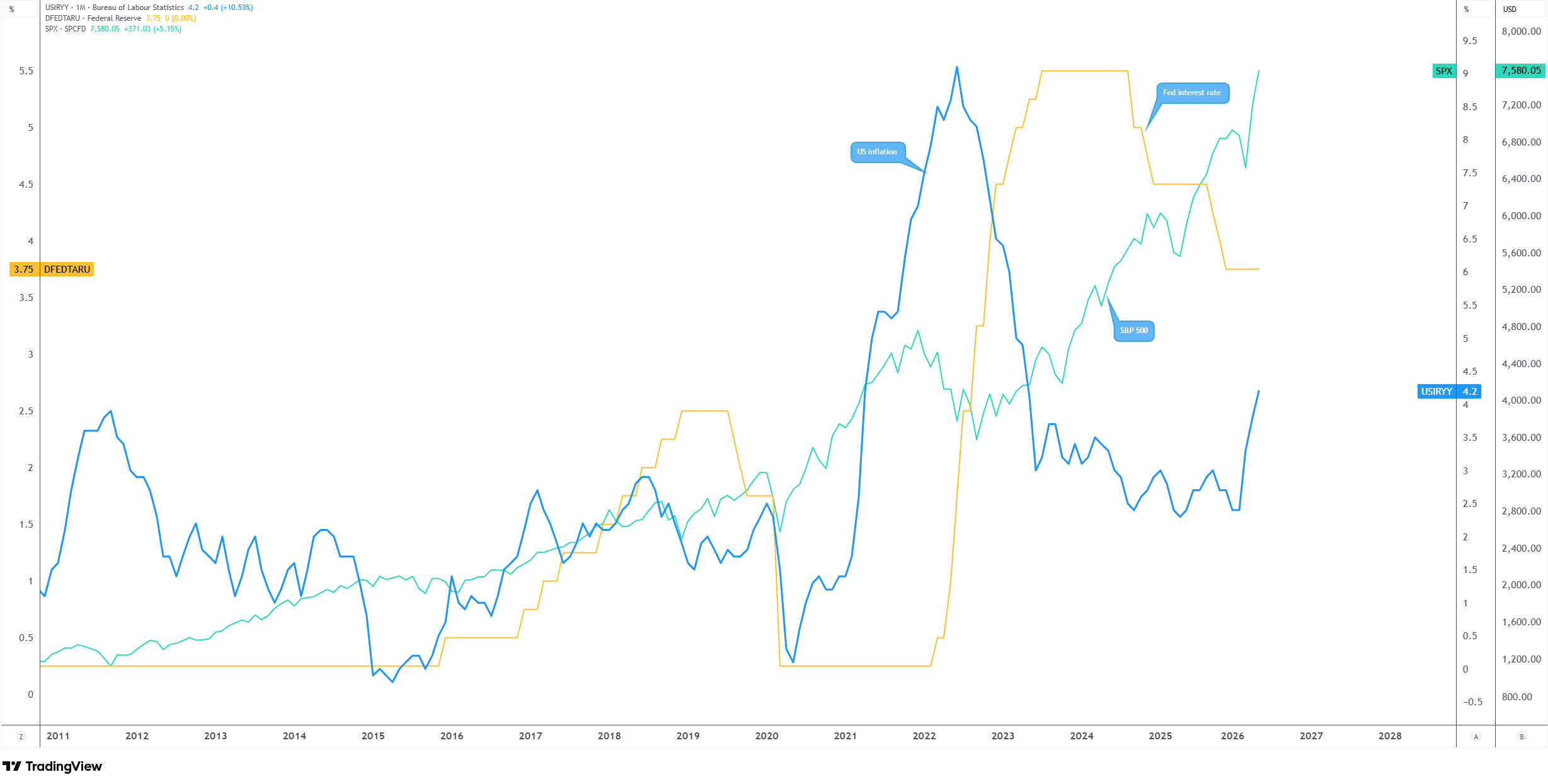
A relatively recent example of this was the 2022 post-pandemic inflation shock. As you can see on the chart below, the YY US CPI inflation rate started picking up in Q2 21, reaching 7% by the end of the year. Once the Fed realised that inflation was not ‘transitory’, the central bank embarked on an aggressive tightening cycle that started in early 2022.
The chart shows that inflation peaked at 9.1% in June 2022, and the Fed raised rates from near zero to 5.5% between March 2022 and mid-2023. I have also overlaid the S&P 500 on this chart to show the impact on stocks – the index shed around 25% from January peaks to September 2022.
How does inflation affect the Commodity market?
The connection between inflationary pressures and commodity prices is an interesting one. Most of us will already know that commodities – such as gold, silver, copper, and iron – are pivotal and provide the foundational materials to produce goods. Think of factories, for example – they require raw inputs to function.
Increased demand for commodities due to a growing economy often drives commodity prices higher. This comes down to basic supply and demand; if demand for these commodities outpaces available supply, prices rise. Why prices rise is due to a number of factors, including the allocation of scarce resources, ensuring that the raw materials go to those who need them most. Suppliers also raise prices to prevent inventory depletion, which helps them cover rising costs as production increases.
You will also find that commodity prices tend to rise faster than inflation, often acting as a leading indicator. Using the same chart as above, but now with copper futures price overlaid (HG1!), you can see that copper turned higher prior to the rise in inflation and rotated lower ahead of its peak. This is due to its relationship/sensitivity to increasing/decreasing demand.
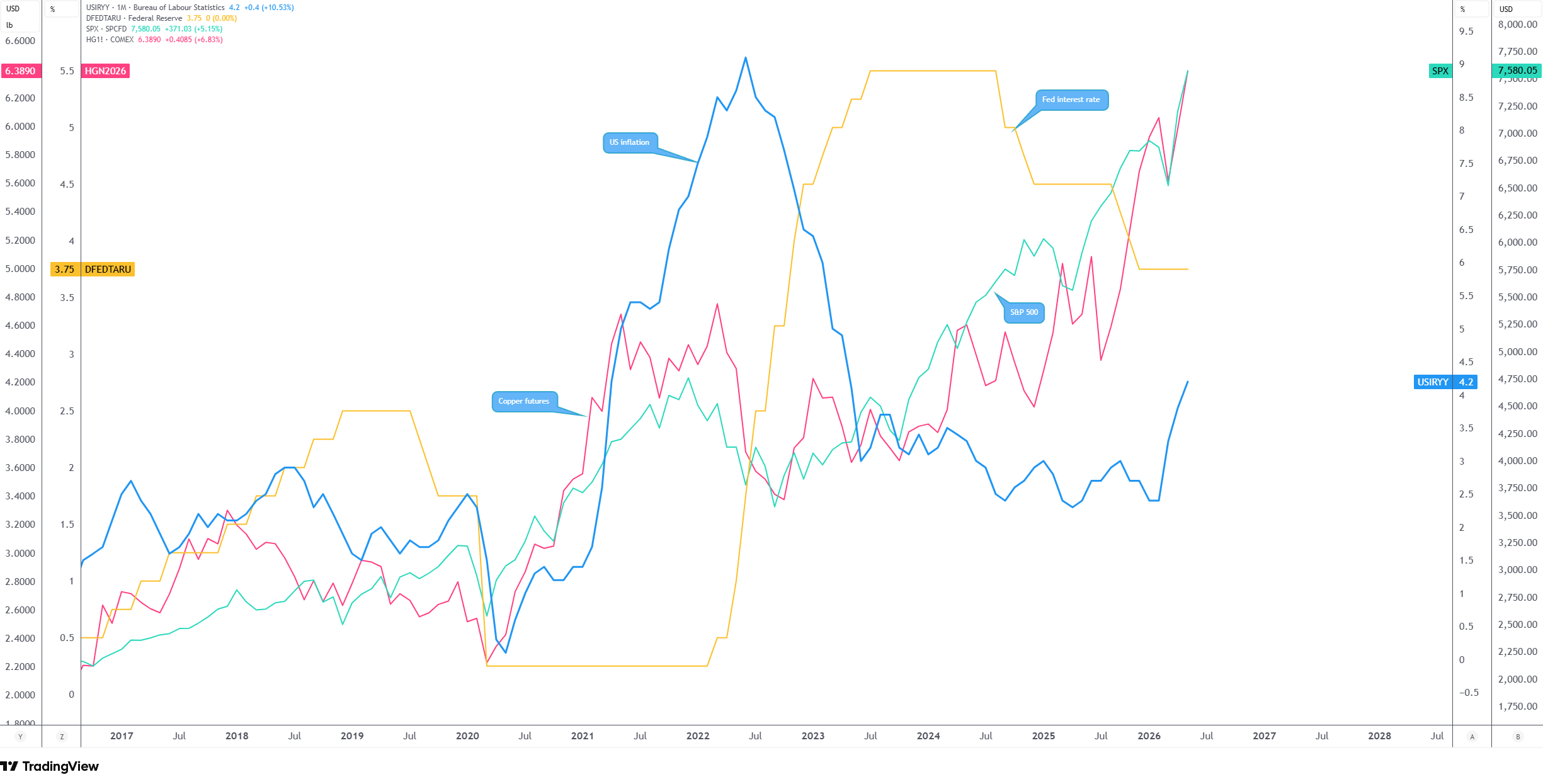
Cost-push inflation can drive raw material prices higher, with these increased costs perhaps passed on to consumers over time. You will also find that during high inflationary periods, commodities tend to outperform many other financial assets, as commodity prices quickly adjust to absorb localised supply shocks.
Final thoughts: Bringing it together
If there is one thing we can take from this, it is that financial markets do not ‘directly’ trade inflation; they trade expectations of how central banks will react. A stronger inflation report increases volatility, depending on what the market interprets it to mean for the future path of interest rates. This is also why a hot inflation print can pull markets in different directions: it may send the USD higher while weighing on equities as investors grow concerned about growth and valuations.
Therefore, next time an inflation report lands, think about how this may affect interest rate expectations, and watch how bond markets react in the immediate aftermath, as well as listen closely to any central bank commentary that follows.
Written by FP Markets Chief Market Analyst, Aaron Hill