
Beginner's guide to stop-loss orders in trading
Reading time: 11 minutes
To say that a protective stop-loss order is important would be an understatement.
Despite some claiming they do not use stop-loss orders and remain successful in the financial markets, I can only speak from personal experience: ‘stops’ are often recommended. For a beginner trader, an important fact about trading is that you will be wrong on some trades, and the stop is there to help limit the loss, hence ‘protective stop-loss order’.
Being caught on the wrong side of a trade – be it a leveraged or an unleveraged one – without anything to prevent it from becoming account-destroying is not a place any trader should put themselves. There is actually no need to put yourself in this position! Beyond the obvious financial setback, a sizeable loss can be psychologically damaging and hard to recover from. There is a good rule that many successful traders live by: limit losses as much as possible while keeping the upside open for gains.
The stop-loss order defined
As a trader in any market – be it in forex (currencies), stocks, indices, commodities, or cryptocurrencies – understanding basic orders is essential. A stop-loss order is an instruction you send to your broker to close a losing trading position.
For example, if you open a buy position in a share CFD (commonly known as being ‘long’), placing a stop-loss order below the entry price level tells your broker that once (or, indeed, if) the CFD position reaches the stop level, it should close out the position at the next available price. Its purpose is to limit further loss beyond what you deemed acceptable.
If, on the other hand, you opened a sell position in a share CFD (often called being ‘short’), positioning a stop-loss order above the entry price level notifies the broker that should price rise by X amount and hit X price level, it will close out your short position at the next available price.
Why is a stop-loss order important?
Unless you have traded a live account with real money before, I believe it is impossible to understand the emotional aspect of this business. I would go as far as to say that trading psychology is the most important factor contributing to your success or failure in trading.
With real money on the line, it is common to be emotional. This is the same whether you are in a winning or losing position. A winning situation can prompt both greed (wanting more profit) and fear (being concerned that the position could turn against you), while a losing situation tends to trigger mainly negative emotions, especially as the price nears the stop level. No one likes losing money, and many of us do not like being wrong. But this is what happens when you have a losing trade.
One of the most important pieces of advice I was given to help me begin to understand this situation was to do all the preparation before entering the market; this includes setting stop levels. So, then, in the midst of the trade, you should have no reason to change things, and if you do, it is an emotional decision rather than an objective one.
The point here is that traders often underestimate how much emotion can interfere with their decision-making once a trade is live. A stop forces you to be disciplined and define your risk before entering a trade, which encourages more thoughtful position sizing. Markets can move sharply on earnings reports, economic data, or geopolitical news. A stop-loss ensures you're not caught flat-footed, especially if you are away from your desk.
Types of stop-loss orders
Standard stop-loss order
Standard stops are the most common. If you have ever used a buy or sell stop-loss order to enter the market above or below the current price, they are essentially the same thing, only that they are used as stops, not entries. Once your stop level is hit, using a standard stop converts it to a market order, executing at the next available price. In fast-moving markets, you may receive a worse price than you would like due to a phenomenon known as ‘slippage’.
Stop-limit order
A stop-limit order combines a stop price with a limit price. Once the stop price is triggered, the order becomes a limit order rather than a market order, meaning it will only execute at your specified limit price or better. This gives you more control over the price you receive, but it comes with a trade-off: if the price gaps down past your limit price, the order may not execute at all, leaving you holding a losing position longer than intended.
Trailing stop-loss order
A trailing stop doesn't sit at a fixed price – it moves with the market. You set it as a percentage or dollar amount below the current price (for a long position), and as the price rises, the stop price rises with it. However, if the price falls, the stop price stays put. This lets you lock in profits as a trade moves in your favour while still protecting against a reversal.
How to set a stop-loss order?
While it is good to understand what a stop-loss order is, why it is important, and the differences between some of the most common stop types, how to set a stop-loss order is equally critical.
Personally, I always try to keep things as simple as possible and position stops using technical analysis, with support and resistance levels often my go-to approach.
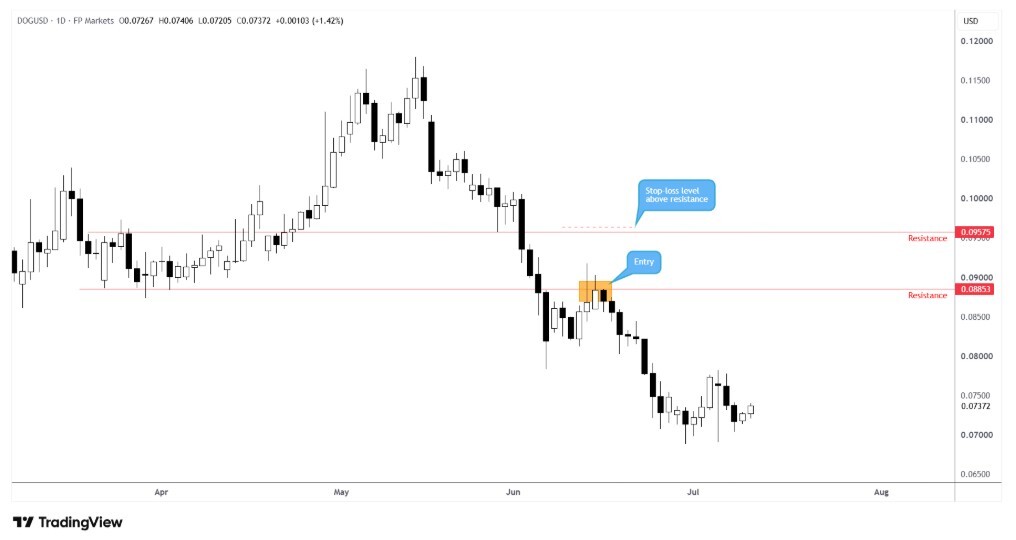
I tend to look at two methods of applying support and resistance, which I demonstrate here. To help illustrate this, the chart below – a daily timeframe of Dogecoin versus the US dollar (DOG/USD) – shows a clear downside bias in this pair since mid-May 2026, and the break of support at US$0.0885 was subsequently retested as resistance. A simple way to apply a stop-loss level if you were interested in selling the retest would be to identify the next layer of resistance and place the stop above that level, which in this case was US$0.0958.
Time-based stop-loss orders
This is one of the simpler exit strategies. The core idea is to set a defined time or number of candle closes in which to liquidate the position.
While I believe a hard stop is still needed here – that is, setting a stop beyond some key technical structure that aligns with your risk parameters – a time-based stop means simply waiting until the predetermined time has elapsed (or a fixed number of candle closes) before closing out the position. Of course, if the trade moves in profit, the time-based approach is shelved and the focus shifts to trade management.
Using the Average True Range (ATR)
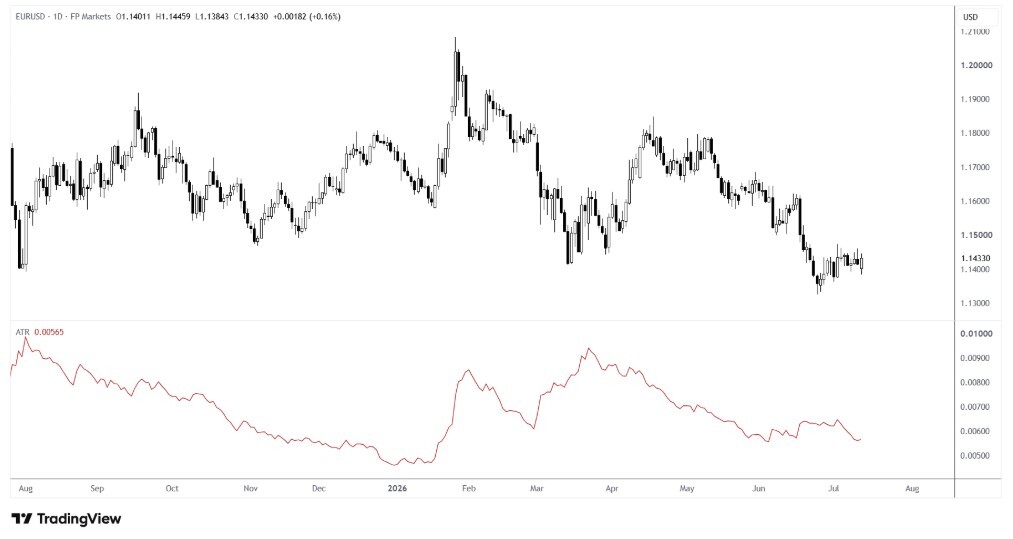
The ATR is a technical indicator that measures the volatility of a market over a given period of time – usually 14 days. You will find that some traders use this indicator to set their stops, typically using a multiple of the ATR, such as 1.5 or 2. So, if a currency pair has an ATR of 50 pips, you would set your stop to 75 or 100 pips to account for the possible volatility.
For example, below is a daily chart of EUR/USD – the euro against the US dollar. The current ATR value is 0.00565. Given that EUR/USD is priced to four decimal places (0.0001), this gives us an approximate value of 56.5 pips (0.00565 / 0.0001), or, if you apply rounding rules, 57 pips. Taking a trade with a stop set by an ATR value of 1.5 means a stop distance of ~85 pips.
Getting started with stop-loss orders
If you are just beginning your trading journey, I would always recommend implementing stop-loss orders. It not only helps set a guardrail for your account equity but also provides an approach to building good trading habits.
Before anything else, you must first decide your risk tolerance per trade. I am sure you have read that the rule of thumb is to generally target about 1 or 2% of your account equity. If you begin trading with US$1,000, risking 1% equates to US$10. As a note, I strongly suggest starting with a small trading account and gradually becoming accustomed to your risk profile. This helps you become familiar with risk in a gradual, controlled manner, rather than jumping in with a US$20,000 account and risking US$200. This is often overwhelming for those not accustomed to risk.
Once risk is defined, you can apply your stop according to your method. If you trade in the Forex market and set your stop at 87 pips, as in the example above, you would then calculate your position size based on your allocated risk and the entry-to-risk distance in pips.
Following this, place the orders according to your approach, and ensure the stop-loss order is placed simultaneously with the entry.
To be clear, stop-loss orders do not make a profitable trader by themselves. As I have said in numerous posts, achieving consistency as a trader requires a unique skill set, including strategy, risk management (with stops as the core of any risk management approach), and an understanding of trading psychology.
But what stops do provide is something every trader needs: a predefined limit on how much a single loss can cost you. As you continue to develop your trading approach, treating stop-loss placement as a core part of your process, not an afterthought, will help protect your capital and keep you in the game long enough to improve.
Written by FP Markets Chief Market Analyst, Aaron Hill
Frequently asked questions (FAQs)
A stop-loss order is an instruction to your broker to close out a losing position, usually at the next available price. It is there to help guard against large trading losses.
A stop-loss order helps traders create disciplined habits by predetermining their risk before entering a trade, prompting them to size trades according to their risk profile.
Traders commonly use technical analysis to determine their stop-loss levels. This can be as simple as support and resistance, or employing technical indicators, such as the ATR or moving averages.